Thunderhead
A self-hosted reverse proxy that passively detects and mitigates bot traffic
Thunderhead is a self-hosted reverse proxy that detects and mitigates bot traffic through passive behavioral analysis — no Cloudflare, no JS challenges, no CAPTCHAs. Inspired by Anubis, it takes a different approach: instead of blocking non-browser clients with a proof-of-work challenge, it scores every request inline and responds proportionally, which makes it effective for APIs and headless traffic that JS challenges can't reach.
How it works
Every request is scored 0–100 across five weighted behavioral signals — robots.txt violations, sequential path crawling, high request rate, suspicious or missing headers, and text-heavy page patterns. Scoring happens inline with zero added latency for legitimate traffic, and every decision is logged as structured JSON for full observability.
Requests are handled with a graduated response:
- < 40 — Allow, pass through
- ≥ 40 — Tarpit, delayed response
- ≥ 75 — Block, 403 Forbidden
Features
- Passive bot detection with zero user friction
- Intent scoring across 5 behavioral signals
- Graduated responses: allow → tarpit → block
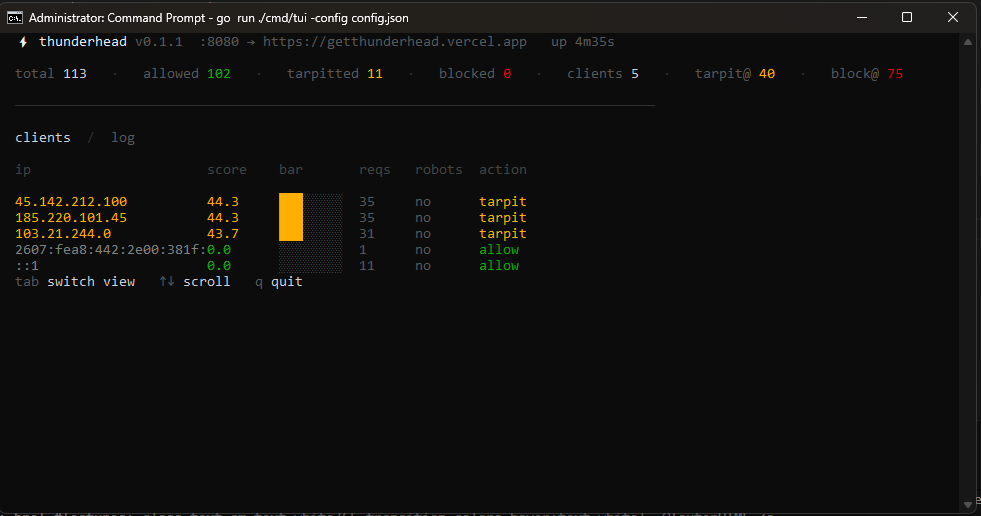
- Real-time terminal dashboard built with Bubbletea (TUI)
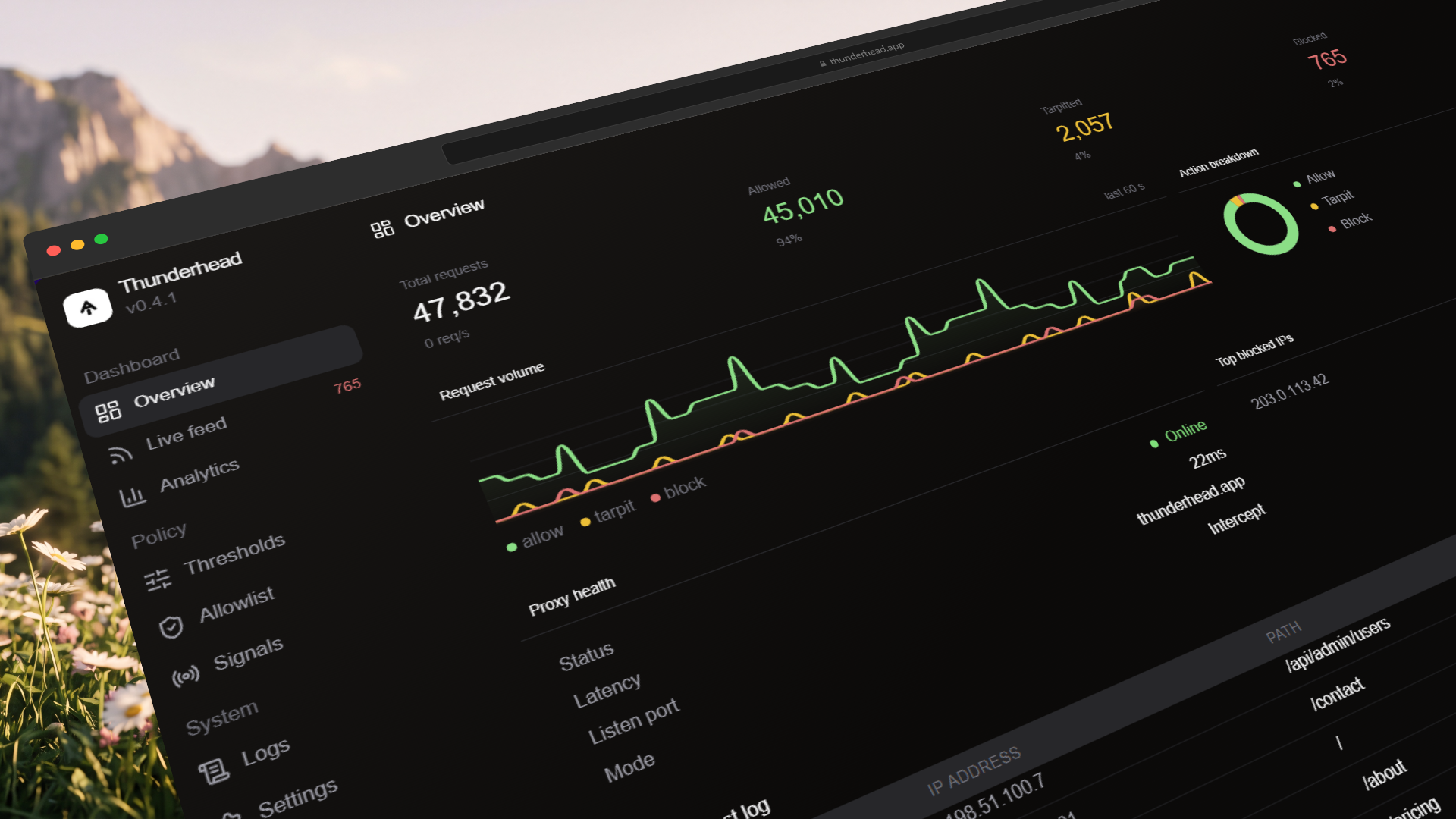
- Web-based status dashboard at
/thunderhead/status - IP, CIDR, and user-agent allowlist/blocklist
- Robots.txt awareness and persistent client state across restarts
- Config hot reload, HTTPS/TLS support
- Embeddable Go middleware (
pkg/middleware) for use in other projects - Docker support with a full docker-compose setup
Why I built it
I wanted to explore an alternative to challenge-based bot mitigation (like Cloudflare or Anubis-style JS challenges), which breaks down for API traffic and headless clients that can't execute JavaScript. Thunderhead instead treats bot detection as a passive, explainable scoring problem — every request gets scored on real behavioral signals and every decision is traceable, without adding latency or friction for legitimate users.
Architecture
The project is organized as a Go backend with a Next.js landing page:
cmd/thunderhead— headless proxy binarycmd/tui— terminal dashboard binaryinternal/analyzer— the intent scoring engineinternal/proxy— request handling, tarpit, block, and dashboard logicinternal/store— persistent client statepkg/middleware— embeddable middleware for other Go projectsweb/— Next.js landing page
What's next
Planned work includes a REST API layer, a standalone Next.js dashboard, a JS-challenge fallback mode, CIDR/subnet-based rate limiting, a systemd service file, and Goreleaser binary releases.